
Table of Contents
- What Languages Are Accepted for Notarization in Dubai?
- Does a Foreign-Language Document Need Arabic Translation?
- How Does a Notary Public Dubai Handle Foreign-Language Documents?
- Can a Foreign Contract Be Notarized in Dubai?
- Why Should You Consult Dubai Lawyers for Foreign-Language Notarization?
- Can a Notarized Foreign-Language Document Be Used Outside the UAE?
- Conclusion
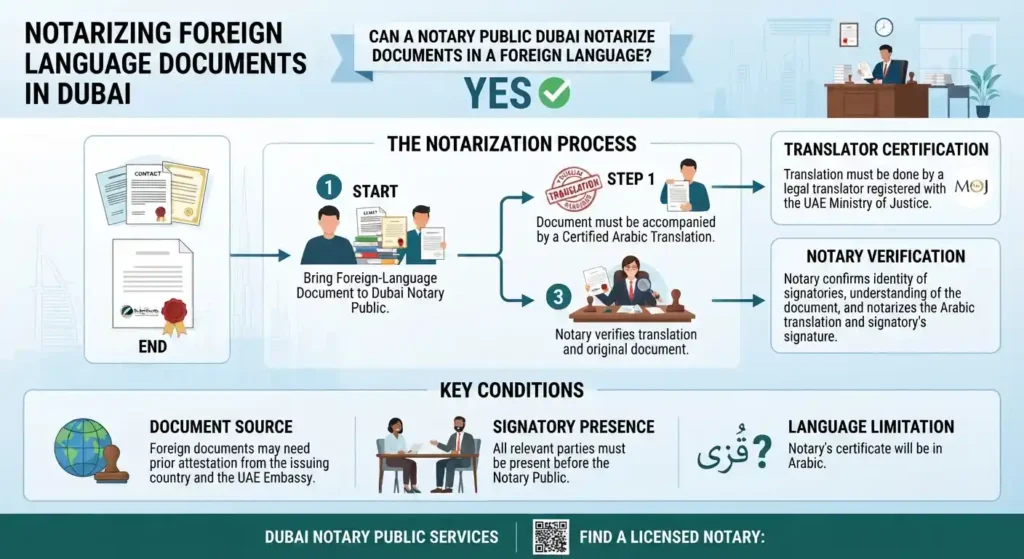
Yes, a Notary Public Dubai can notarize certain documents written in a foreign language, provided they meet the applicable legal and procedural requirements. However, the notarization process may require an Arabic translation, particularly when the document is intended for official use in the UAE. The specific requirements depend on the type of document, its language, and the authority receiving it.
Foreign-language documents are common in Dubai because individuals and businesses frequently deal with international contracts, overseas transactions, immigration procedures, and cross-border legal matters. Notarization helps establish the authenticity of signatures and declarations, but applicants must ensure that their documents comply with the requirements of the relevant notarial authority.
What Languages Are Accepted for Notarization in Dubai?
Arabic is the official language of the UAE’s legal system. However, certain notarial services may accommodate documents prepared in other languages, subject to the applicable procedures.
English is frequently used in commercial and personal documents, particularly those involving international businesses and expatriates. Other foreign languages may also be accepted in specific circumstances.
The acceptance of a foreign-language document does not automatically mean that it can be notarized without translation. Depending on the document and the service requested, the notary may require an approved legal translation into Arabic.
Applicants should confirm the language requirements before submitting their documents to avoid unnecessary delays.
Does a Foreign-Language Document Need Arabic Translation?
In many situations, an Arabic translation is required when a foreign-language document is submitted for official notarization or use before UAE authorities.
For example, an individual presenting a foreign-language affidavit may need to provide an Arabic legal translation so that the contents can be properly understood and processed.
A translation may also be necessary when a document contains legal terminology, contractual obligations, declarations, or other information that must be clearly understood by the receiving authority.
The translation should accurately reflect the original document. Applicants should use an appropriately licensed legal translator where certified translation is required.
How Does a Notary Public Dubai Handle Foreign-Language Documents?
The process generally involves several stages, depending on the type of document and the requested notarial service.
- Reviewing the Original Document
The applicant first submits the original document or an acceptable electronic copy for preliminary review. The notary or relevant authority examines its nature, language, and purpose.
This helps determine whether the document qualifies for notarization and whether additional requirements apply.
- Arranging a Legal Translation
If an Arabic translation is required, the applicant must arrange for the document to be translated through an appropriately authorized legal translation provider.
The translated version should accurately communicate the meaning of the original document without changing its legal effect.
- Verifying the Applicant’s Identity
The Notary Public Dubai may request identification documents, such as a valid Emirates ID or passport, depending on the applicant’s circumstances.
Identity verification is important when the notarization involves signing a declaration, executing an agreement, or confirming a statement.
- Checking Signatures and Legal Capacity
Where applicable, the notary verifies the identity of the signatory and confirms that the person has the necessary legal capacity and consent to execute the document.
For corporate documents, additional authorization or company records may be required to establish the signatory’s authority.
- Completing the Notarization
Once the applicable requirements are satisfied, the notary completes the relevant procedure. This may involve witnessing a signature, administering an oath, registering an instrument, or attesting a document, depending on the service requested.
The notarized document can then be used for its intended purpose, subject to any additional requirements imposed by the receiving authority.
Can a Foreign Contract Be Notarized in Dubai?
Foreign-language contracts may be eligible for certain notarial services in Dubai, but the procedure depends on the nature of the agreement and the purpose of notarization.
For instance, an agreement involving business arrangements, financial obligations, or property-related matters may require specific formalities before it can be notarized.
If the contract is intended for use before a UAE government department or court, an Arabic translation may be necessary. The parties should also verify whether notarization is legally required or whether another form of authentication is sufficient.
Seeking legal advice before submitting an international contract can help prevent problems involving translation, execution, and enforceability.
Why Should You Consult Dubai Lawyers for Foreign-Language Notarization?
Foreign-language notarization can involve additional legal and administrative requirements. A document that is accepted in one country may not automatically satisfy the formalities required in the UAE.
Experienced Dubai lawyers can help individuals and businesses understand the applicable notarization procedures before submitting their documents. They can review the original document, identify translation requirements, and explain whether further authentication is necessary.
Their assistance can be particularly useful for:
- International commercial agreements.
- Foreign affidavits and sworn declarations.
- Overseas property transactions.
- Corporate resolutions and authorization documents.
- Documents intended for use before UAE courts.
- Personal declarations required by government authorities.
Dubai lawyers can also advise whether a document needs notarization, legal translation, attestation, or consular authentication. This distinction is important because these procedures serve different legal purposes.
Professional legal assistance can reduce the risk of submitting incomplete or incorrectly prepared documents and help ensure that the notarization process meets the relevant requirements.
Can a Notarized Foreign-Language Document Be Used Outside the UAE?
Yes, a document notarized in Dubai may be used internationally, depending on the requirements of the destination country.
However, notarization alone may not be sufficient. The receiving country may require additional authentication, an apostille where applicable, embassy legalization, or a certified translation.
The applicant should check the requirements of the relevant foreign authority before completing the notarization process.
For example, a notarized document intended for use in another jurisdiction may need further verification by the appropriate UAE authorities and the destination country’s diplomatic mission.
Conclusion
A Notary Public Dubai can handle certain documents written in foreign languages, subject to the applicable notarial procedures and translation requirements. Arabic translation may be necessary when documents are intended for official use in the UAE, particularly when their contents involve legal declarations, contractual obligations, or formal proceedings.
Applicants should confirm the requirements for their specific documents before beginning the process. Consulting experienced Dubai lawyers can help clarify translation, notarization, and authentication requirements, ensuring that foreign-language documents are properly prepared for their intended legal use.

Admin
Editorial contributor at WhiteDots.ae covering UAE business, real estate, and digital life.