
What Is an Annual Maintenance Contract?
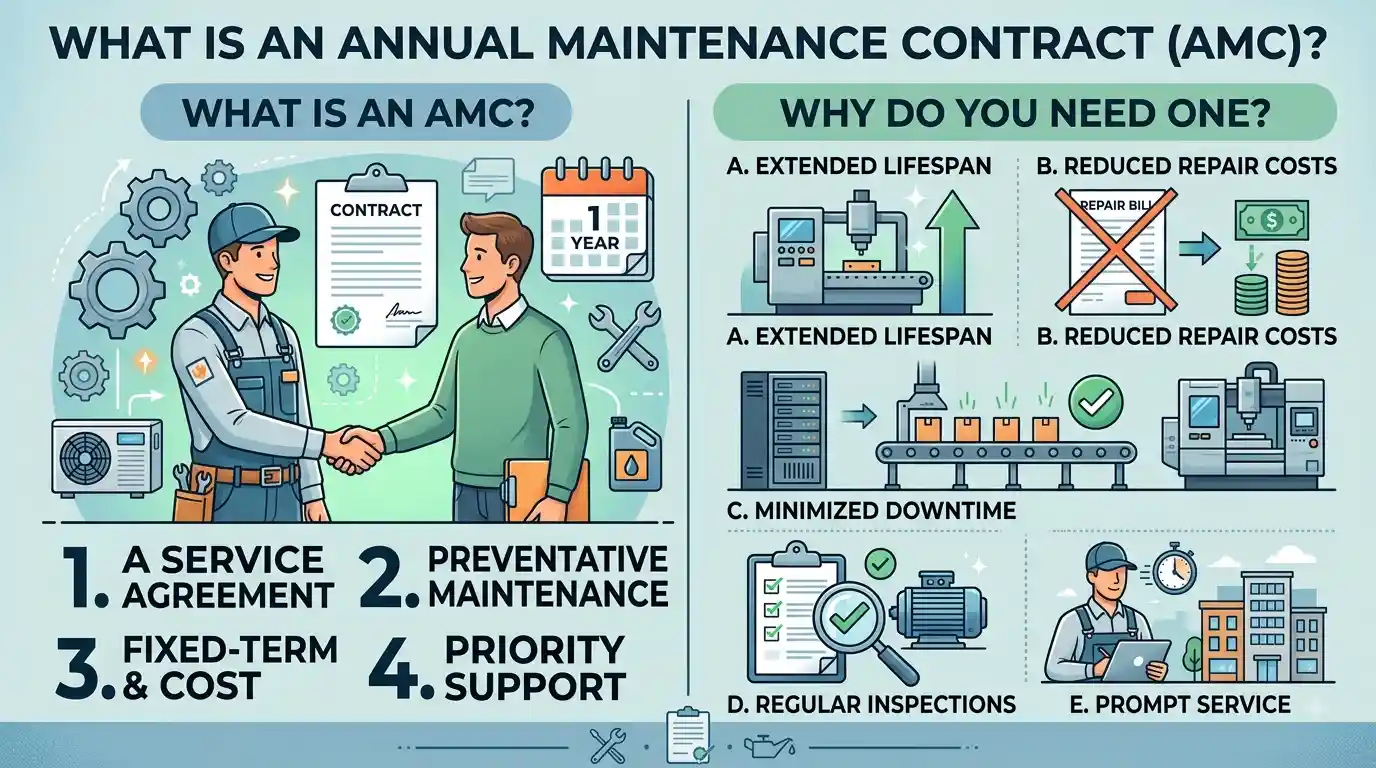
An Annual Maintenance Contract (AMC) is a service agreement between a customer and a maintenance provider that covers the regular inspection, servicing, and repair of equipment, systems, or facilities for a specific period, usually one year. Instead of contacting a maintenance company every time a problem occurs, businesses and property owners can rely on a planned maintenance arrangement throughout the contract period.
Maintenance is an important part of managing any commercial property, office, residential building, or business facility. Equipment and building systems naturally experience wear and tear over time. Without regular inspections and servicing, small issues can eventually become expensive breakdowns. An annual maintenance contract provides a structured way to keep essential systems operating efficiently.
Depending on the provider and the type of contract, an AMC may cover preventive maintenance, routine inspections, emergency support, repairs, replacement of certain components, and technical assistance. The exact services depend on the agreement between the customer and service provider.
How Does an Annual Maintenance Contract Work?
An annual maintenance contract begins when a customer selects a suitable maintenance provider and agrees to the services included in the contract. Before signing the agreement, both parties normally discuss the equipment, property systems, maintenance requirements, service frequency, response times, and associated costs.
Once the agreement is active, the maintenance company follows a scheduled maintenance plan. Technicians may visit the property at predetermined intervals to inspect equipment, identify potential problems, clean components, perform adjustments, and carry out necessary servicing.
If an unexpected problem occurs during the contract period, the customer can contact the maintenance provider for assistance according to the terms of the agreement. This can make maintenance management more convenient and predictable.

Why Is an Annual Maintenance Contract Important?
Regular maintenance is essential for keeping equipment and property systems reliable. Waiting until something breaks can result in operational interruptions, higher repair expenses, and unnecessary inconvenience.
An annual maintenance contract focuses on planned and preventive maintenance rather than relying only on emergency repairs. Technicians can identify signs of wear and potential faults before they develop into serious problems.
For businesses, this can be particularly valuable because equipment failures may affect employees, customers, productivity, and daily operations. A structured maintenance plan helps businesses manage these risks more effectively.
Key Benefits of an Annual Maintenance Contract
Reduced Unexpected Repair Costs
One of the major advantages of an annual maintenance contract is better control over maintenance expenses. Regular servicing can identify minor problems before they require major repairs.
Although an AMC involves an upfront or recurring service cost, preventive maintenance can potentially reduce the frequency of expensive emergency repairs. Businesses can also plan their maintenance budget more effectively because many services are covered under a predefined agreement.
Better Equipment Performance
Equipment that receives regular professional maintenance is more likely to operate efficiently. Dust, damaged components, poor connections, and normal wear can gradually affect performance.
Routine inspections and servicing help keep systems in better operating condition. This can contribute to consistent performance and reduce the chances of avoidable interruptions.
Longer Equipment Lifespan
Replacing commercial equipment can be expensive. Regular maintenance helps protect equipment from premature deterioration by addressing problems at an earlier stage.
An annual maintenance contract can therefore support the long-term use of equipment and systems. Proper servicing, cleaning, adjustments, and timely repairs can help equipment remain functional for a longer period.
Improved Safety
Faulty equipment and poorly maintained systems can create safety concerns in workplaces and buildings. Electrical problems, mechanical faults, damaged components, and other maintenance issues should not be ignored.
Professional maintenance inspections can help identify potential safety problems and ensure that equipment and systems are maintained according to appropriate service requirements.
Convenient Maintenance Management
Managing maintenance independently can take considerable time, especially for businesses with multiple systems or large properties. An AMC provides a dedicated maintenance provider that handles scheduled servicing and support.
Instead of searching for a technician every time an issue occurs, the customer already has an established relationship with a maintenance company.
What Services Can an AMC Include?
The services included in an annual maintenance contract depend on the type of equipment and the maintenance provider. Some contracts focus mainly on preventive maintenance, while others provide broader repair and support services.
Common services can include routine inspections, cleaning, testing, adjustments, preventive servicing, troubleshooting, minor repairs, and emergency assistance.
For building maintenance, an AMC may cover systems such as air conditioning, electrical installations, plumbing, generators, fire safety equipment, elevators, or other essential facilities.
Before signing a contract, customers should carefully review the service scope. It is important to understand which services are included and which may involve additional charges.
Annual Maintenance Contract vs. On-Demand Maintenance
Businesses generally have two common approaches to maintenance: planned contract-based maintenance and on-demand maintenance.
With on-demand maintenance, a customer contacts a service provider whenever a problem occurs. This approach can work for occasional or minor maintenance requirements, but it may become costly when equipment requires frequent servicing.
An annual maintenance contract provides an ongoing relationship with a maintenance provider. Regular inspections and scheduled servicing can help identify potential issues before they become major failures.
The better option depends on the customer’s requirements, equipment condition, usage level, and budget. Businesses that depend heavily on their equipment may benefit more from a structured annual maintenance plan.
How to Choose the Right Annual Maintenance Contract
Choosing the right maintenance provider requires more than simply comparing prices. Customers should consider the provider’s experience, technical expertise, service coverage, response time, and reputation.
It is also important to check exactly what the contract includes. Customers should understand the maintenance schedule, number of visits, emergency support, replacement parts, repair coverage, exclusions, and additional charges.
A clear agreement can prevent misunderstandings later. Businesses should choose a provider that can meet their specific technical and operational requirements.
What Should You Check Before Signing an AMC?
Before signing an annual maintenance contract, carefully review the terms and conditions. Make sure the contract clearly explains the services that will be provided and the responsibilities of both parties.
The agreement should also specify the contract duration, maintenance schedule, service response time, payment terms, renewal conditions, and cancellation policy.
Customers should pay particular attention to exclusions. Some maintenance contracts cover labor but charge separately for spare parts, while others may include specific components within the agreed price.
Understanding these details in advance makes it easier to compare different maintenance providers and select an appropriate contract.
Who Can Benefit From an Annual Maintenance Contract?
An annual maintenance contract can be useful for a wide range of customers. Commercial offices, retail stores, factories, warehouses, hotels, residential buildings, property owners, and other organizations may use maintenance contracts to manage their facilities.
The value of an AMC is particularly noticeable when a property depends on multiple systems that require regular inspection and servicing. Having one maintenance provider can simplify the process and provide a more organized approach to facility management.
Final Thoughts
An Annual Maintenance Contract provides a structured approach to maintaining equipment, building systems, and essential facilities throughout the year. Instead of waiting for problems to occur, customers can use planned maintenance to identify potential issues, improve reliability, and manage maintenance requirements more efficiently.
From reducing unexpected breakdowns to supporting equipment lifespan and simplifying maintenance management, an AMC can provide significant value for businesses and property owners. However, choosing the right provider and carefully reviewing the contract terms are essential for getting the most from the agreement.
A well-planned maintenance contract is not simply an expense. It can be an important part of protecting equipment, maintaining operational efficiency, and supporting the long-term performance of a property or business.
Related Reading: Why Businesses in the UAE Need a Regular Legal Audit
Related Reading: Real Estate Consultants — full guide
Related Reading: عروض رمضان: خصومات مذهلة من هواوي تصل إلى 1400 ريال سعودي! — full guide
Related Reading: El crecimiento del turismo en Dubái y las noticias más relevantes — full guide