
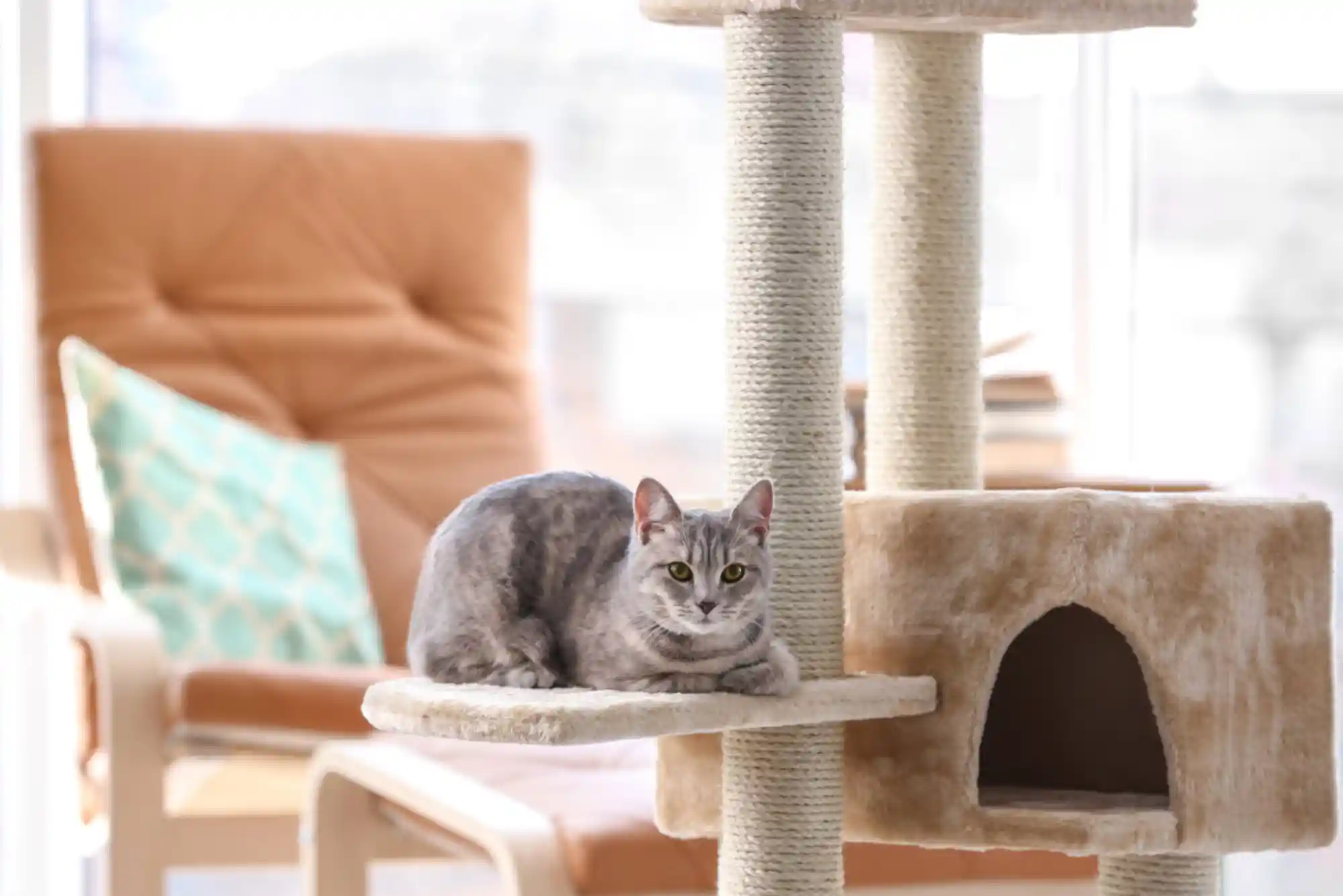
Introduction
If your cat has turned the sofa, dining chairs, or curtains into a personal scratching station, you are not alone. Scratching is a normal and important feline behaviour, so the goal is not to stop scratching altogether. Instead, you need to give your cat a more appealing place to do it. Learning how to stop cats from scratching furniture starts with understanding why cats scratch and setting up scratching posts in locations your cat actually wants to use.
A successful scratching setup combines the right post, suitable texture, proper height, strategic placement, and positive reinforcement. Simply buying a scratching post and placing it in an unused corner often does not work. Cats choose scratching locations based on comfort, visibility, scent, routine, and how satisfying the surface feels beneath their claws.
With a thoughtful approach, you can protect your furniture while allowing your cat to express a completely natural behaviour.
Why Do Cats Scratch Furniture?
Before learning how to stop cats from scratching furniture, it helps to understand why scratching happens in the first place. Cats scratch for several reasons, and none of them involve deliberately trying to destroy your belongings.
Scratching Maintains the Claws
Scratching helps cats condition their claws by removing older outer layers. It also gives them an opportunity to stretch their paws, legs, shoulders, and back.
A sturdy scratching surface provides resistance that feels satisfying. If a sofa offers a tall, stable surface with a pleasant texture, your cat may naturally choose it over a lightweight scratching post that wobbles.
Scratching Is a Form of Communication
Cats have scent glands in their paws. Scratching can leave both visible marks and scent information, making it a form of territorial communication.
This is one reason cats may scratch prominent areas such as doorways, sofas, and furniture near entrances. These locations are socially important from a cat’s perspective.
Scratching Helps Cats Stretch and Exercise
Notice how your cat often stretches immediately after waking? A good scratching session can serve a similar purpose. Vertical scratching allows a cat to extend its body and engage several muscle groups.
For this reason, the best scratching post is not necessarily the prettiest one. It needs to be functional.
How to Stop Cats from Scratching Furniture with the Right Post
The scratching post itself is one of the most important parts of the solution. If your cat ignores it, look at the design before assuming your cat is being difficult.
Choose the Correct Height
For cats that scratch vertically, choose a post tall enough for the cat to stretch almost completely from nose to toes.
A short post may technically be a scratching post, but it may not provide the full-body stretch your cat is seeking. Larger cats may need particularly tall and sturdy equipment.
Make Stability a Priority
A scratching post should remain firmly in place when your cat pulls against it.
If the post tips, slides, or shakes, your cat may lose interest. Some cats will actively avoid unstable equipment after one unpleasant experience.
A broad, weighted base or a securely mounted scratching surface can make a significant difference.
Offer Different Textures
Cats have individual preferences. Some enjoy sisal, while others prefer cardboard, wood, carpet-like materials, or other textured surfaces.
If you are unsure what your cat likes, experiment rather than buying several identical posts. A vertical sisal post and a horizontal cardboard scratcher can provide useful variety.
Scratching Post Placement Matters More Than You Think
One of the biggest mistakes owners make when learning how to stop cats from scratching furniture is placing the scratching post too far away from the furniture being damaged.
If your cat scratches the side of the sofa, put the scratching post directly beside that area initially. Once the cat begins using it regularly, you can gradually move it to a more convenient location.
Place Posts Near Sleeping Areas
Cats frequently stretch and scratch after waking. A scratching post near a favourite sleeping area can therefore become a natural part of the cat’s routine.
This is especially useful for cats that scratch furniture shortly after naps.
Use Socially Important Locations
Cats often prefer scratching where their activity is visible. A scratching post hidden in a dark, unused room may receive little attention.
Try placing one near a doorway, living room, or another area where your household spends time. The post should be accessible without forcing your cat to cross an uncomfortable or unfamiliar space.
Make the Scratching Post More Attractive
Buying the right equipment is only half the process. You also need to make it interesting enough for your cat to investigate.
Use Play to Introduce the Post
Interactive play can encourage a cat to approach and interact with a scratching post. Drag a favourite toy near the post and allow your cat to discover the surface naturally.
Do not force the cat’s paws onto the scratching material. Forced interaction can make the object less appealing and may create unnecessary stress.
Reward Desired Behaviour
When your cat uses the scratching post, provide positive reinforcement. Depending on what motivates your cat, this could be praise, play, affection, or a small food reward.
Timing matters. Reward the behaviour soon after it happens so your cat can make the connection between using the post and receiving something pleasant.
Consider Catnip Carefully
Catnip can make some cats more interested in a scratching surface, although not every cat responds to it. If your cat enjoys catnip, a small amount around the scratching area may encourage investigation.
Do not worry if catnip has no effect. Individual cats respond differently, and the quality and placement of the scratching surface remain more important.
Protect Furniture While Your Cat Learns
Even with an excellent scratching post, changing a well-established habit takes time. Temporary furniture protection can help prevent your cat from continuing to practise the unwanted behaviour.
You can cover vulnerable areas with materials that make scratching less satisfying while keeping the approved scratching surface nearby.
The objective is not to frighten or punish the cat. Instead, you are making the furniture less rewarding while making the scratching post easier and more enjoyable to use.
For additional practical guidance, explore these Cat Scratching Fixes for ideas on managing common scratching problems.
What Not to Do When Stopping Furniture Scratching
Understanding what not to do is just as important as choosing the right scratching post.
Do Not Punish Your Cat
Yelling, hitting, chasing, or physically punishing a cat for scratching can create fear without teaching the behaviour you actually want.
Your cat may simply learn to scratch when you are not watching. Worse, punishment can damage trust and increase stress.
Redirecting and rewarding appropriate scratching is a more constructive approach.
Do Not Remove Every Scratching Opportunity
The answer to furniture damage is not to prevent scratching altogether. Cats need appropriate opportunities to scratch, stretch, and communicate.
Instead, provide several acceptable surfaces throughout the home.
Do Not Expect Instant Results
A cat that has scratched the sofa for months may not immediately switch to a new post. Consistency matters.
Keep the approved scratching area available, reward its use, and make the unwanted furniture less attractive during the transition.
How Many Scratching Posts Does a Cat Need?
There is no single number that works for every household. One post may be sufficient for a small home, but multiple scratching locations are often more practical, particularly in larger homes or households with multiple cats.
Think about where your cat already scratches, sleeps, and spends time. Providing an appropriate scratching surface near those locations makes adoption easier.
Multiple cats may also have different preferences. One cat might prefer vertical sisal, while another may favour a horizontal cardboard scratcher.
The goal is to create enough choice that your cat does not have to compete for access to a preferred scratching area.
How to Stop Cats from Scratching Furniture at Night
Some cats become especially active at night. If your cat scratches furniture during evening or early-morning activity, consider whether boredom, excess energy, or environmental stimulation is contributing.
A predictable evening routine involving interactive play can help provide appropriate mental and physical activity. Follow play with a calm period and access to food or another normal part of the cat’s routine.
Place a scratching post near the furniture your cat targets at night. If the post is several rooms away, your cat may simply continue using the nearby sofa.
When Scratching Suddenly Changes
A sudden increase or change in scratching behaviour deserves attention. Stress, environmental changes, conflict with another pet, changes in routine, or other underlying issues can sometimes affect behaviour.
If scratching becomes excessive, destructive, compulsive, or is accompanied by other unusual changes, speak with a veterinarian or qualified feline behaviour professional.
Pheromone products are sometimes used as part of a broader behaviour-management plan. For general information about feline behaviour and Pheromone Therapy for Cats, consult reputable animal-welfare and veterinary resources rather than relying on pheromone products alone.
Creating a Cat-Friendly Scratching Routine
The most effective approach to how to stop cats from scratching furniture is to make the correct behaviour easy and rewarding.
Start by observing your cat. Which furniture does it scratch? Is the scratching vertical or horizontal? Does it happen after sleeping, during play, near doorways, or when visitors arrive?
Use those observations to choose the appropriate scratching surface and location.
For example, a cat that scratches the vertical arm of a sofa may need a tall, stable vertical post positioned directly beside the sofa. A cat that scratches rugs may prefer a horizontal or angled scratcher.
Once your cat consistently uses the approved surface, you can gradually improve the placement of the furniture-protection strategy without removing the scratching option.
For broader pet-care resources and related guidance, you can also explore Whitedots.
How Long Does It Take to Stop Furniture Scratching?
Every cat is different. Some cats investigate a new scratching post immediately, while others need several days or weeks of consistent encouragement.
The most important factors are relevance and consistency. A scratching post that matches your cat’s preferred position, texture, height, and location has a much better chance of success.
Avoid constantly moving the post or replacing it before your cat has had time to become familiar with it.
Once the cat has developed a reliable habit, you can make gradual adjustments if necessary.
Give Your Cat a Better Place to Scratch
Learning how to stop cats from scratching furniture is less about stopping a natural behaviour and more about redirecting it. The right scratching post should be tall or appropriately shaped, stable, comfortable, and placed where your cat already wants to scratch.
Pay attention to your cat’s individual preferences, introduce the scratching area positively, protect vulnerable furniture during training, and reward appropriate behaviour consistently. With patience, most cats can learn that the scratching post is the preferred place to stretch their claws.
FAQs
How do I get my cat to stop scratching my furniture?
Provide an appealing scratching post close to the furniture your cat currently scratches. Choose a stable surface with the appropriate height and texture, then reward your cat whenever it uses the approved scratching area. Temporary furniture protection can help during the transition.
Why does my cat keep scratching the couch when it has a scratching post?
The scratching post may not match your cat’s preference. It could be too short, unstable, poorly positioned, or made from a texture your cat dislikes. Try placing a suitable scratching surface directly beside the couch.
How do you train a cat to use a scratching post?
Place the post near an existing scratching location and encourage exploration through play. Reward your cat when it uses the post. Avoid forcing its paws onto the surface or punishing it for scratching elsewhere.
What smell do cats hate to scratch furniture?
There is no universally reliable smell that will stop every cat from scratching furniture. Strong deterrents may also create stress or cause your cat to avoid an area without teaching an appropriate alternative. Redirecting scratching toward suitable surfaces is generally a better long-term strategy.
Should I put catnip on a scratching post?
If your cat responds to catnip, a small amount may increase interest in the scratching post. However, many cats either do not respond to catnip or do not need it. The post’s stability, texture, size, and location are usually more important.
Is it normal for cats to scratch furniture?
Yes. Scratching is a normal feline behaviour used for claw maintenance, stretching, exercise, communication, and marking. The goal is to provide appropriate scratching outlets rather than eliminate the behaviour.